
I gave a plug a few months ago for one of the best classes I ever took, The Kinesthetic Classroom. In case you forgot, the class was all about using movement during teaching to enhance learning (the mind-body connection).
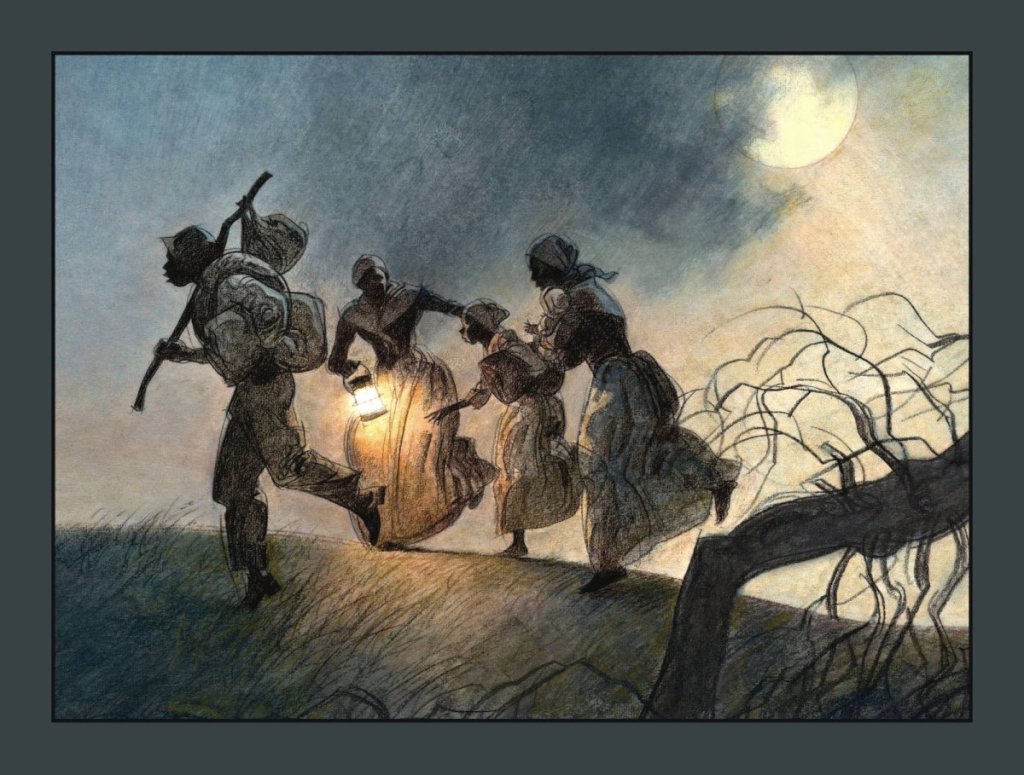
Not only did the instructor show us all kinds of creative, engaging activities, but we learned a ton of new ideas from each other. Perhaps the most memorable lesson any of my peers shared was an interactive experience based on The Underground Railroad.
The premise was as simple as it was brilliant: a student would volunteer to be a runaway slave. The rest of the class could either be sideline observers or they could scatter around the room as participants with secret cards (more on that in a moment). The objective was for the “runaway slave” to get from one side of the room (The South) to the other (Canada) without getting caught.
Sounds easy, right? Did I mention that the volunteer was blindfolded? Also, the whole room was arranged so that objects and people crowded the intervening space, and the “runaway slave” had to be *very careful* who or what they touched.
If the “runaway slave” bumped into an object, no big deal–they could just go around it. Some objects might even give clues: a jacket could be draped over one side of a chair simulating moss on the north side of a tree. Find that and you could angle yourself toward freedom a little better.
HOWEVER, if the “runaway slave” touched a person in the room, that person would stop them and reveal what their card said. It was possible the person was a sympathetic farmer offering safe haven, or an Underground Railroad guide who could escort them on their journey. More likely, though, the person was a slave owner, or a police officer, or someone who would turn them in for a reward. One wrong step and the “runaway slave” could be captured and sent back, with no hope of reaching freedom.
I cannot overstate how gripping this activity is. I was just an observer, and I was riveted, the whole room watching in nervous silence as the volunteer edged their way forth. My classmate who set up this demonstration, a high school social studies teacher, acted as a guide for the “runaway slave” to make it a little more sporting, explaining certain things as they went. Still, he had no idea which participants had which cards, and there were times when he had to lead the volunteer toward one of two people…would he choose correctly?
This lesson is amazing on so many levels. First of all, it brings the content to life in a very immersive way. The set up is minimal, and everyone can be as involved as they want. You can give multiple students a chance to try the various roles, and it’s never the same experience twice. And, most importantly, the meaning of the lesson is OBVIOUS without having to lecture or give out notes. The learning is immediately internalized–“the message is in my bones,” one classmate said.
Now, if you teach this exact content, this activity is perfect for your classroom as is. However, you can readily adapt it to all sorts of grade levels and content areas to suit you. For example, I did a similar type of activity when we read Shipwreck at the Bottom of the World, the true story of Ernest Shackleton’s doomed voyage to cross the South Pole. Instead of trying to reach Canada from the South, with sympathetic abolitionists intermixed with ruthless slave hunters in the way, I had students trying to get from Antarctica to South Georgia Island, while sea leopards and glaciers and deadly storms awaited them among hidden caches of food and spare boats that could get them to dry land quicker. I even had the option that students could work as a group or split up and try different paths, to see if they fared better together or separately (teamwork being a central theme in the story); even those few students who made it on their own felt bad that their teammates didn’t survive.
In short, students got the message intuitively, yet no less fully, than they would have if I had just told them the message, or had them read it on their own and take notes, or even if they simply watched a movie reenacting the events. There’s something about doing that makes learning stick. If that’s your goal, definitely try more ways to have your students do in your class.
 M. J. Lau